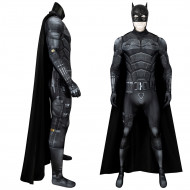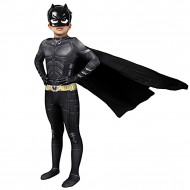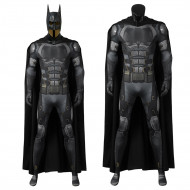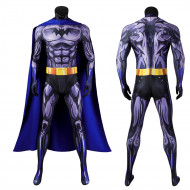
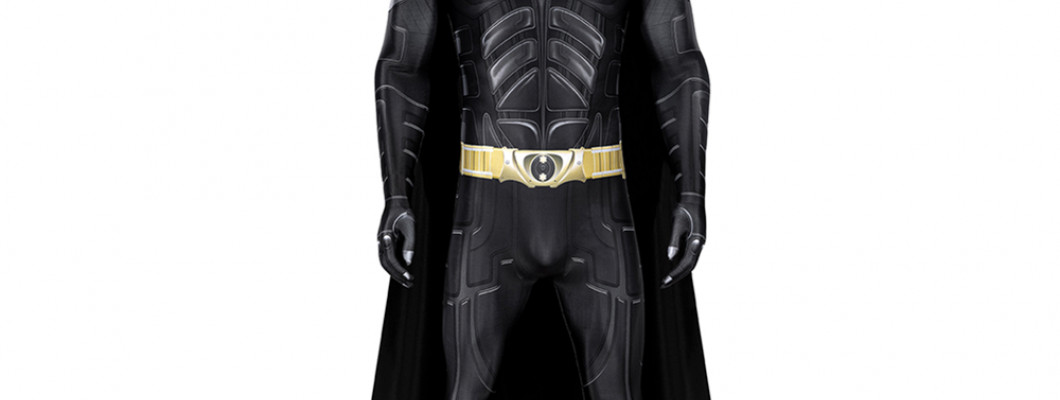
There is no single default Batman costume anymore. A gray suit with a yellow emblem, Michael Keaton's sculpted black Batsuit, Christian Bale's segmented armor, Ben Affleck's massive gray-and-black design, and Robert Pattinson's layered charcoal suit all read unmistakably as Batman. Put them beside one another, though, and they barely look like variations of the same costume.
That is what makes choosing a Batman version harder than it first appears. The important differences are not tiny continuity details. They are the things you notice immediately: cowl shape, ear length, chest emblem, color blocking, armor treatment, cape, and overall silhouette.
The easiest way to choose is to decide what kind of Batman you want to portray before comparing individual costumes.
The Fastest Way to Tell Batman Costume Versions Apart
Most recognizable Batman designs fall into a handful of visual families.
| Batman style | Typical look | Chest emblem | Overall impression |
|---|---|---|---|
| Classic comic | Gray with blue or black accents | Yellow oval or black bat | Graphic, traditional superhero |
| Gothic black | Mostly black | Yellow oval or dark bat | Sculpted, theatrical |
| Tactical armor | Black or charcoal | Smaller integrated bat | Technical, equipment-driven |
| Heavy gray-and-black | Gray torso with black cape and cowl | Very wide black bat | Broad, imposing |
| Grounded modular | Layered charcoal and black | Angular integrated emblem | Utilitarian, assembled |
| Animated | Large gray and dark color blocks | High-contrast yellow oval | Clean, stylized |
These categories overlap. Batman has been redesigned too many times for neat boxes to survive intact. They are still more useful for costume selection than memorizing release dates.
Classic Gray Batman: The Most Graphic Version
The classic Batman look relies on strong areas of contrasting color rather than detailed armor.
A gray body is usually framed by a darker cowl, cape, gloves, and boots. The utility belt provides another horizontal band of contrast, while the chest emblem creates an obvious focal point. Some interpretations use a yellow oval around the bat symbol; others place a black bat directly against the gray torso.
This style reads clearly because relatively few elements compete for attention.
At a distance, you still see:
dark cowl;
pointed ears;
gray torso;
large bat emblem;
contrasting belt;
dark cape.
That simplicity gives classic Batman costumes their comic-book quality.
Longer ears reinforce the effect. They pull the head silhouette upward and make the cowl appear sharper and more dramatic. Combined with a cape and gray body, the result feels much closer to illustrated Batman than to modern tactical gear.
Choose this direction if the Batman in your head wears gray first and armor second.
Keaton's Black Batsuit Turned Batman Into a Gothic Silhouette
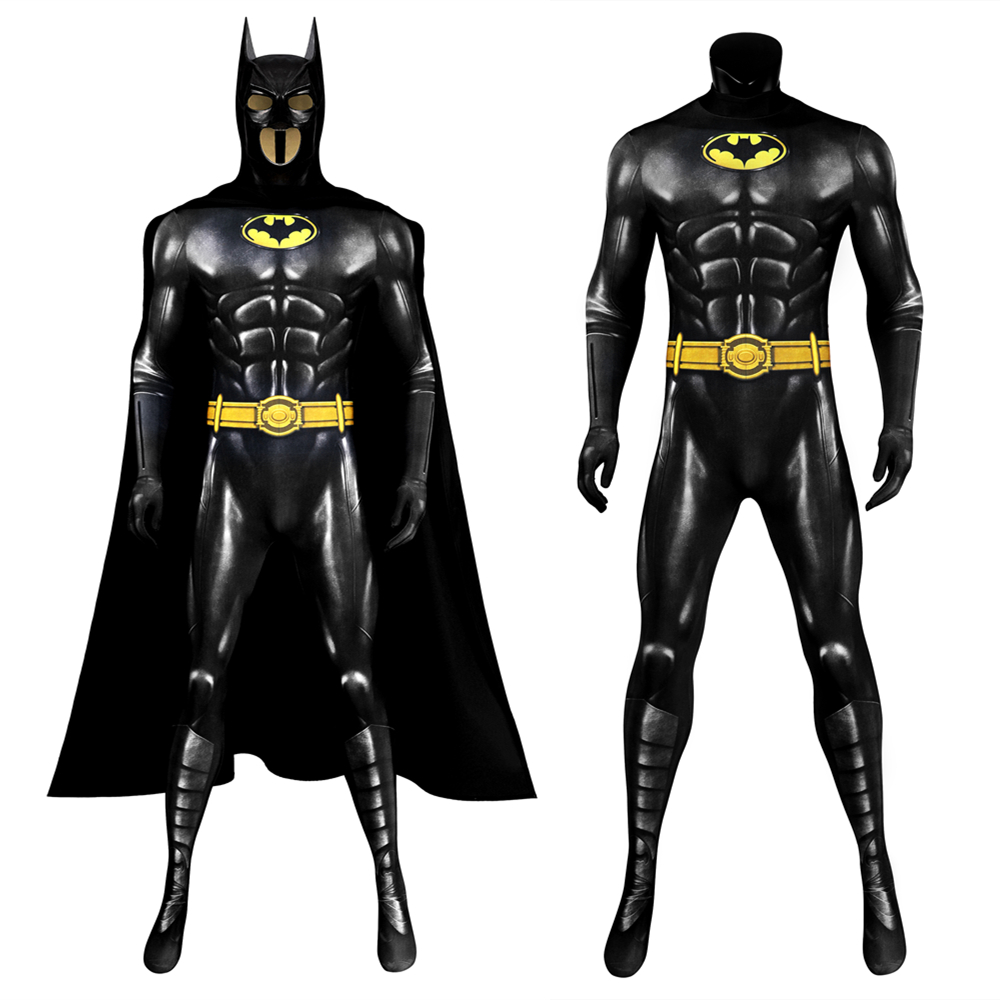
The late-1980s movie interpretation pushed Batman heavily toward black.
Instead of separating the costume into large gray, black, and yellow regions, the design relies on sculpted surfaces within a predominantly dark silhouette. The cape, torso, cowl, gloves, and boots visually merge much more than they do on traditional comic designs.
That changes what your eye notices.
On a classic costume, color blocking explains the character almost immediately. On a Keaton-style Batman, recognition depends more heavily on:
the tall pointed ears;
sculpted chest and abdomen;
broad black cape;
strong shoulder shape;
contrasting chest emblem.
The yellow oval becomes especially noticeable because there is so little competing color around it.
A mostly black Batman does not simply look like a darker classic suit. It shifts attention away from graphic color separation and toward shape, surface, and silhouette.
For someone who associates Batman with Gothic movie imagery, this remains one of the clearest visual directions.
Bale's Dark Knight Look Makes Batman Tactical
Christian Bale's Batman moves farther away from the visual language of a simple superhero suit.
The body is broken into numerous armor sections rather than presented as one continuous sculpted surface. The torso, shoulders, arms, and legs contain smaller shapes and divisions that suggest equipment built for a purpose.
From farther away, you still see a dark Batman silhouette. Up close, however, your attention moves toward:
armor panels;
mechanical-looking divisions;
reinforced joints;
layered torso construction;
functional-looking equipment.
The costume therefore feels more technical than graphic.
This is why a Nolan-style Batman and a classic gray Batman can produce completely different impressions even if both retain the familiar cape, cowl, belt, and emblem arrangement.
One treats those pieces as elements of a superhero design. The other makes them look like parts of a tactical system.
Dense armor detail is not a secondary feature here. It is one of the main things that defines the version.
Affleck's Batman Is Broad, Gray, and Deliberately Heavy
Ben Affleck's principal Batman v Superman suit shifts Batman back toward gray and black, but it does not return to the lighter proportions of many comic interpretations.
The silhouette is much broader.
Several details reinforce that impression:
very short cowl ears;
thick neck area;
large gray torso;
dark cape and cowl;
enormous black chest emblem;
relatively restrained surface segmentation.
The short ears matter more than they may seem. Longer ears create vertical emphasis around the head. Short ears make the cowl appear wider and heavier.
The chest symbol produces a similar effect across the torso.
Instead of sitting like a compact logo in the middle of the chest, the black bat spreads far across the gray body. Its wings visually connect a much larger portion of the upper torso.
The result makes this version especially easy to distinguish from many other movie Batsuits at a distance.
It is also a useful alternative for someone who wants a modern movie Batman without choosing an almost entirely black costume.
Gray does more than reference the comics here. It separates the body from the cape and cowl, making the major shapes easier to distinguish.
Choose this family if you prefer Batman to look broad, dense, and heavily comic-influenced without abandoning a modern movie aesthetic.
Pattinson's Batman Looks Layered Rather Than Sculpted
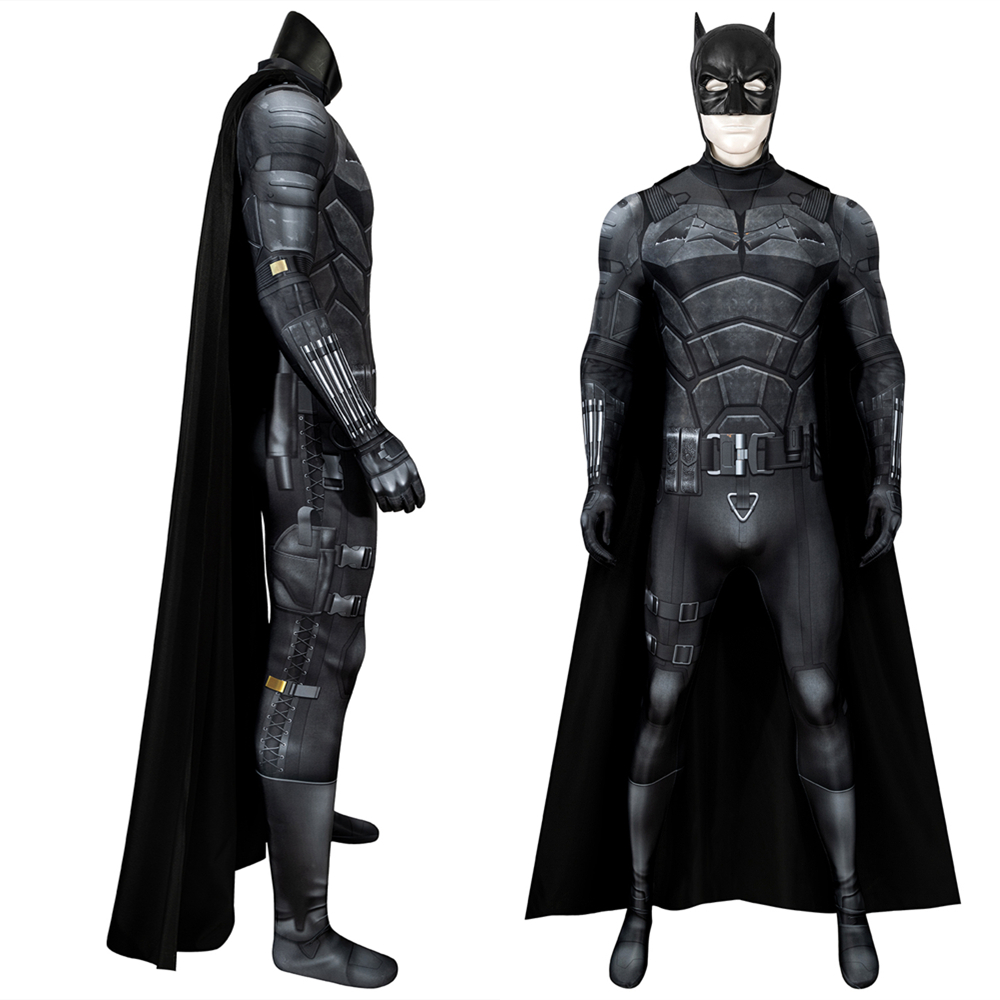
Robert Pattinson's suit takes another route.
Instead of presenting Batman as either a smooth superhero figure or a body covered in highly regular armor panels, the costume looks assembled from visible components.
The palette stays within charcoal and black, so there are no bright yellow areas competing for attention. That puts more emphasis on construction lines and individual pieces.
The chest emblem is especially distinctive. Rather than sitting cleanly on top of the torso as a separate graphic symbol, it appears integrated into the surrounding armor.
The overall effect is more utilitarian.
You notice:
layered chest sections;
visible seams and divisions;
dark utility equipment;
compact cowl proportions;
an angular chest symbol;
relatively little bright contrast.
That gives Pattinson's Batman a different visual rhythm from Bale's.
Both can be described as armored, but Bale's design looks systematically segmented. Pattinson's reads more like separate pieces of equipment assembled into a Batsuit.
That distinction is more useful than simply calling both versions "black Batman armor."
Animated Batman Proves That More Detail Is Not Always More Recognizable
Batman: The Animated Series sits almost at the opposite end of the spectrum from modern armored Batman.
Its strength comes from simplification.
Large areas of gray, dark blue or black, yellow, and shadow define the character without dense surface texture. The emblem and utility belt remain highly visible, while the shoulders, cape, cowl, and torso are built from strong shapes.
That matters when translating an animated Batman into a costume.
Trying to add realistic armor everywhere can actually move the design away from what makes the animated version recognizable.
The visual identity depends more on:
broad shoulders;
clean gray torso;
dark cape and cowl;
prominent yellow belt;
clearly visible chest emblem;
simple, exaggerated shapes.
This is why animated Batman can remain instantly recognizable without hundreds of printed armor lines.
The eye sees the overall composition first.
For cosplay or costume selection, animated styles make sense when bold Batman iconography matters more than realistic tactical construction.
Where Video Game Batman Fits
Video game Batman often occupies a middle ground between traditional comic styling and cinematic armor.
The Arkham games are a useful example. Many Arkham-inspired designs retain recognizable gray-and-black color blocking and comic-like proportions while adding denser surface detail, heavier armor treatment, and more technical equipment than a traditional illustrated suit.
That combination creates a distinct visual balance.
You still read the large Batman shapes first, but closer inspection reveals substantially more construction detail than on an animated or classic comic design.
Game-inspired versions therefore make sense for someone who wants comic-derived Batman proportions with a more armored, technical finish, without committing to one specific live-action interpretation.
There is no need to treat every alternate game skin as a separate Batman species. Humanity has created enough taxonomies already.
The Cowl Can Change the Entire Version
When comparing Batman costumes, the cowl deserves more attention than many buyers give it.
Ear length alone can move the design noticeably toward one era or another.
Longer ears
Long ears create a sharper, more vertical silhouette. They often feel closer to Gothic or traditional comic interpretations.
They are particularly noticeable in profile and in full-body images where smaller surface details may disappear.
Shorter ears
Short ears reduce that vertical emphasis.
They make the head appear broader and are strongly associated with designs such as Affleck's principal Batman v Superman cowl.
The exposed lower face
The shape of the eye openings, cheeks, nose, and exposed jaw also changes how much of the wearer's face becomes part of the design.
Some cowls frame the face relatively openly. Others produce a heavier helmet-like appearance.
When two Batman costumes seem broadly similar, compare the cowl silhouettes before worrying about tiny torso details. It is often the faster way to identify which version you are actually looking at.
The Chest Emblem Is More Than a Logo
The bat symbol can completely reorganize the front of a Batman costume.
A yellow oval emblem becomes an obvious focal point because its contrast pulls attention toward the center of the chest.
A black bat against gray creates a more direct comic-book effect, particularly when the wings spread widely across the torso.
A small dark emblem on black armor is much less dominant. Armor texture and silhouette become more important instead.
Affleck's especially wide bat symbol changes the apparent proportions of the torso because it stretches so far horizontally.
Pattinson's angular emblem works differently again. It visually belongs to the surrounding equipment rather than floating as an isolated graphic mark.
If you are trying to identify a Batman version quickly, the chest is one of the first places to look.
Gray-and-Black and All-Black Batman Read Very Differently
Color is not merely a question of preference.
It determines which parts of the costume remain distinct at a glance.
With a gray-and-black design, the torso separates clearly from the cape, cowl, gloves, and boots. The viewer can read the costume as several large shapes even before noticing smaller details.
With an almost entirely black design, those boundaries become less obvious.
The costume then relies more heavily on:
reflections;
armor contours;
cape outline;
emblem contrast;
cowl shape.
That is why gray Batman costumes can look highly graphic even when they include significant printed or sculpted detail, while black Batman designs often feel more unified and imposing.
Neither approach is inherently better.
They simply communicate different versions of the character.
Which Batman Costume Version Should You Choose?
The useful question is not which Batsuit is objectively best. People have spent decades ranking them and Gotham remains stubbornly unimproved.
Choose according to the visual identity you actually want.
Choose a classic comic-style Batman if you want:
strong gray-and-dark color blocking;
a prominent emblem and belt;
less emphasis on realistic armor.
Choose a Keaton-style Batman if you want:
an almost entirely black silhouette;
tall ears and Gothic styling;
sculpted rather than segmented body detail.
Choose a Dark Knight-style Batman if you want:
dense segmented armor;
a technical, equipment-driven appearance;
a mostly black or charcoal palette.
Choose an Affleck-style Batman if you want:
a broad gray-and-black silhouette;
very short cowl ears;
an oversized black chest symbol.
Choose a Pattinson-style Batman if you want:
layered dark construction;
an integrated angular emblem;
a grounded, assembled-equipment look.
Choose an animated Batman if you want:
clean graphic shapes;
high-contrast classic iconography;
minimal dependence on realistic armor detail.
Compare the Version Before Comparing the Costume
Once you know which Batman you want to portray, shopping becomes considerably easier.
Do not begin by comparing two random Batman costumes according to price, accessories, or surface detail if one is based on an animated gray suit and the other is based on Pattinson's layered armor. They are solving completely different visual problems.
Start with the version.
Compare the cowl silhouette, chest emblem, color blocking, armor density, cape presentation, and overall proportions. Once those elements match the Batman you have in mind, details such as included pieces, sizing, and construction options become worth comparing.
For a broader look at available interpretations, the XheroSuits Batman costume collection includes movie, animated, and game-inspired versions. The useful approach is not to treat them as interchangeable Batman suits, but to decide which design family fits your target look first.
Batman has changed costumes for decades because each adaptation wants to communicate something slightly different about him. A classic gray suit presents a superhero. Keaton creates a Gothic figure. Bale emphasizes tactical armor. Affleck creates visual mass. Pattinson makes the suit feel assembled and utilitarian. Animation strips the design back to its strongest shapes.
Choosing the right version starts with deciding which of those visual ideas actually looks like Batman to you.